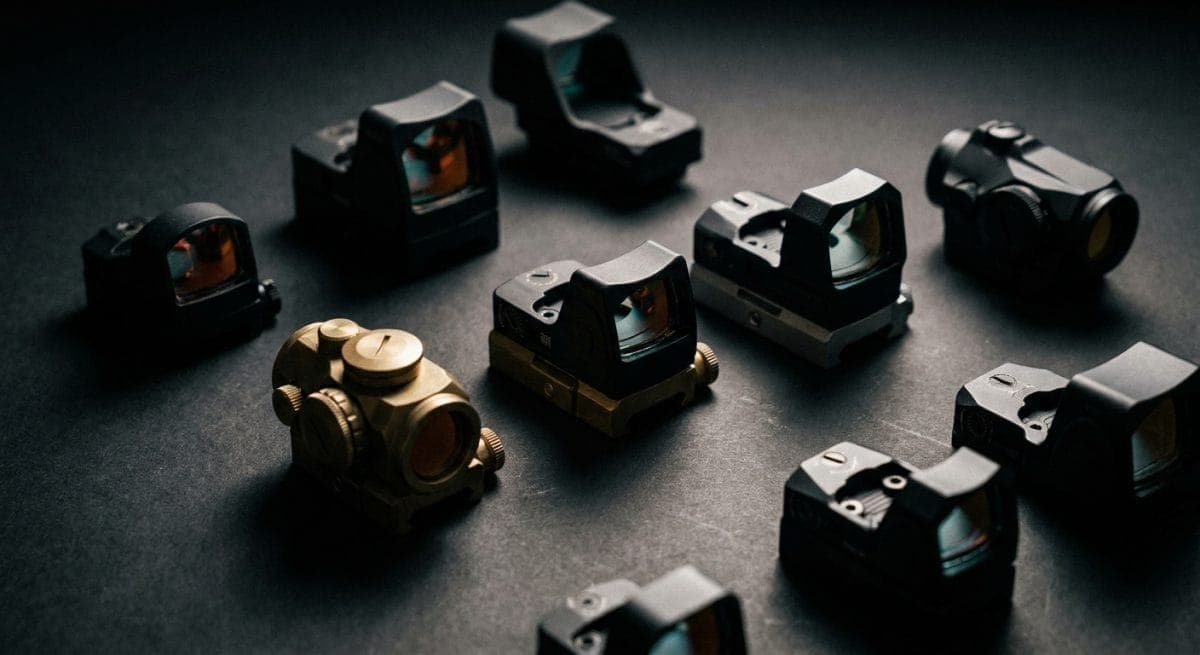
MOA Vs MRAD Explained
MOA vs MRAD Explained: A Shooter’s Guide to Angular Measurement
Few debates in the precision rifle world generate more confusion than the choice between MOA (minute of angle) and MRAD (milliradian). Both systems measure angles, both are used to adjust scope turrets and hold for wind and elevation, and both are precise enough for sub-MOA accuracy at extended ranges. The difference lies in the math, the granularity of adjustment, and the community you shoot with. This guide breaks down what each unit actually measures, how they compare on real turrets, and which one makes sense for your next build.
What Is MOA?
A minute of angle is 1/60th of one degree. Since a full circle contains 360 degrees, it also contains 21,600 minutes of angle. In practical shooting terms, 1 MOA subtends approximately 1.047 inches at 100 yards. Most shooters round this to “1 inch at 100 yards” for quick field math, though the true value becomes meaningful at longer ranges. At 1,000 yards, 1 MOA equals 10.47 inches, not 10 inches flat.
Most MOA-based scopes use 1/4 MOA click values, meaning each click of the turret moves point of impact roughly 0.26 inches at 100 yards. Some target and F-class optics offer 1/8 MOA clicks for even finer resolution, while a handful of hunting scopes use 1/2 MOA clicks to reach elevation faster.
MOA Quick Reference
| Distance | 1 MOA equals | 1/4 MOA click |
|---|---|---|
| 100 yards | 1.047 in | 0.26 in |
| 300 yards | 3.14 in | 0.79 in |
| 600 yards | 6.28 in | 1.57 in |
| 1,000 yards | 10.47 in | 2.62 in |
What Is MRAD?
A milliradian is 1/1000th of a radian. A full circle contains 2 pi radians, or roughly 6,283 milliradians. In the field, 1 MRAD subtends 3.6 inches at 100 yards, or exactly 10 centimeters at 100 meters. The metric relationship is what makes MRAD so clean for range estimation and ballistic calculation: 1 MRAD equals 1 meter at 1,000 meters.
Standard MRAD scopes use 0.1 MRAD clicks, which translates to 0.36 inches at 100 yards or 1 cm at 100 meters. A few high-end competition optics offer 0.05 MRAD clicks for finer resolution, though 0.1 MRAD remains the industry standard for tactical and precision rifle scopes.
MRAD Quick Reference
| Distance | 1 MRAD equals | 0.1 MRAD click |
|---|---|---|
| 100 yards | 3.6 in | 0.36 in |
| 300 yards | 10.8 in | 1.08 in |
| 600 yards | 21.6 in | 2.16 in |
| 1,000 yards | 36 in | 3.6 in |
Resolution and Adjustment Range
On paper, 1/4 MOA clicks (0.26 in at 100 yards) appear finer than 0.1 MRAD clicks (0.36 in at 100 yards). The difference is 0.1 inch per click at 100 yards, which is real but rarely decisive. At typical precision rifle ranges of 600 to 1,000 yards, both systems deliver adjustments smaller than the inherent dispersion of a sub-MOA rifle and the shooter’s ability to read wind.
Where the two systems diverge meaningfully is in total adjustment range and reticle real estate. A modern MRAD scope like the Vortex Razor HD Gen III 6-36×56 offers 35 MRAD of total elevation travel, equivalent to roughly 120 MOA. That is enough to push a 6.5 Creedmoor well past 1,500 yards without holding over. The MOA version of the same optic typically advertises travel in the 120 to 140 MOA range, so the two are comparable when you account for unit conversion.
Reticle Design and Holdover Math
Modern first focal plane (FFP) scopes are where the MOA vs MRAD debate gets practical. An FFP reticle subtends the same angular value at any magnification, so holdovers work at all powers. Both MOA and MRAD reticles can be designed with fine subtensions, but MRAD reticles tend to be cleaner because the base unit is larger. A typical MRAD tree reticle breaks down into 0.2 MRAD increments, while a comparable MOA reticle might use 1 MOA or 2 MOA spacing. Neither is inherently better, but the decimal math of MRAD (0.1, 0.2, 0.5, 1.0) is simpler to call out under stress than fractional MOA (1/4, 1/2, 3/4).
Ranging with the Reticle
For reticle-based ranging, MRAD has a clear math advantage when you work in metric targets:
- Target size in meters x 1000 / mils read = range in meters
- Target size in yards x 1000 / mils read = range in yards
The MOA equivalent requires a conversion factor of 95.5 or 27.77 depending on units, which is workable but less elegant:
- Target size in inches x 95.5 / MOA read = range in yards
For shooters who use laser rangefinders, this advantage disappears. For those who want a backup ranging method or shoot in organizations that prohibit LRFs, MRAD holds an edge.
Which System Is More Popular?
MOA dominates American hunting and general-purpose shooting. Walk into any sporting goods store and the majority of variable scopes on the shelf will be MOA, especially in the sub-$500 price bracket. Brands like Leupold, Vortex Diamondback, and Nikon Prostaff have historically built their volume around MOA turrets and BDC reticles calibrated in inches.
MRAD dominates tactical and precision rifle competition. The U.S. military standardized on mils decades ago, and organizations like the Precision Rifle Series (PRS) see MRAD on the overwhelming majority of top-finishing rifles. The shared language matters: when a spotter calls “hold 0.4 left, 2.1 up,” every MRAD shooter on the line understands instantly. Mixed systems create friction.
Glass Quality and the Unit Question
Turret units have nothing to do with optical performance. Glass quality comes from the objective lens coatings, ED (extra-low dispersion) elements, mechanical tolerances, and assembly precision. A $2,500 MOA scope from Nightforce or Zeiss will outperform a $400 MRAD scope from a budget brand every day of the week. When evaluating an optic, assess these factors independently of the unit choice:
- Resolution (measured in line pairs per millimeter on USAF 1951 test targets)
- Edge-to-edge clarity and chromatic aberration control
- Low-light transmission (typically 88 to 95 percent in premium glass)
- Tracking accuracy on a tall target test (box tests should return to zero within 0.1 MRAD or 0.25 MOA)
- Turret feel, click definition, and zero-stop reliability
Top-tier glass houses, Schmidt and Bender, Tangent Theta, Kahles, Zero Compromise, offer both MOA and MRAD configurations of the same scope body. The optical performance is identical. Choose the unit, then evaluate the glass.
How to Choose for Your Build
The decision comes down to three questions:
1. Who do you shoot with?
If your shooting partners, local club, or competition circuit uses MRAD, choose MRAD. If you hunt with a group that still thinks in inches and yards, MOA will feel natural. Matching your community eliminates translation errors.
2. What reticle do you want?
Precision tree reticles tend to be cleaner and more intuitive in MRAD. Hunting BDC reticles and simple duplex designs are more common in MOA. Look at the reticle library from manufacturers like Vortex, Bushnell Elite Tactical, and Athlon before committing.
3. How do you think about distance?
If you naturally think in inches and yards, MOA will feel intuitive. If you work in metric or already use mils professionally, MRAD will click faster. Neither is objectively superior.
Once you have your optic selected, pair it with a rifle platform built to match its precision. Shooters building a purpose-driven precision AR or DMR setup can spec barrels, handguards, triggers, and complete uppers at ar15outfitters.com to match the capability of the glass on top.
Mixing Systems: Don’t
The single most important rule in this discussion is to never mix MOA and MRAD on the same rifle. A scope with an MOA reticle and MRAD turrets (or vice versa) was briefly offered by some manufacturers in the early 2000s and has been roundly abandoned. Your reticle subtensions and turret clicks must share the same unit. Any dope card, ballistic app setting, and spotter call needs to be in one consistent system.
Bottom Line
MOA and MRAD are two different rulers measuring the same angular space. MOA offers slightly finer clicks at 1/4 MOA and speaks the language of American hunters who think in inches. MRAD offers cleaner math, decimal-based communication, and the dominant standard in tactical and competition circles. The glass, the mechanical tracking, and the reticle design matter far more than the unit stamped on the turret cap. Pick the system your community uses, learn it cold, and put rounds downrange.
About this guide
Researched with public technical specs and manufacturer documentation, cited inline above. Reviewed by the Rifle Optics World editorial team. Updated when underlying specs or methodology change.
Published on April 16, 2026. Last updated April 28, 2026.
Written and reviewed by the RifleOpticsWorld. See our editorial guidelines and how we make money.
This guide was drafted with the assistance of a large language model and fact-checked and edited by a human editor before publication. Product recommendations and Optics Scores referenced here are produced by our human review team. Outbound retailer links are affiliate links.