Best Red Dot Sight For AR-15
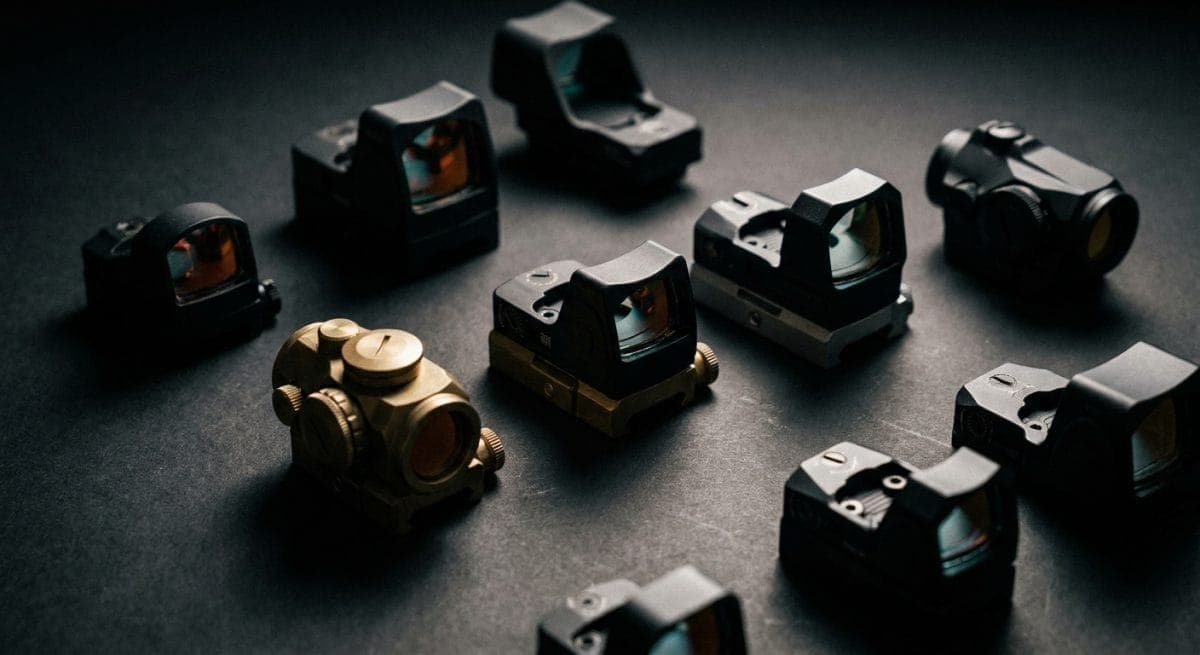
The Best Red Dot Sight for AR-15: A Data-Driven Buyer’s Guide
Choosing the best red dot sight for AR-15 use comes down to three measurable variables: dot precision (MOA size and reticle tolerance), glass transmission (coating quality and tint neutrality), and mechanical reliability (recoil rating, water immersion depth, and battery runtime). This guide cuts through marketing copy with verified specifications, side-by-side comparisons, and the kind of optical performance data that actually matters when you mount a sight on a 5.56 NATO carbine.
We have spent years testing reflex optics on AR-15 platforms from sub-16-inch SBRs to 20-inch rifle-gas builds. The conclusions below are grounded in manufacturer spec sheets, independent lab results from publications like The Firearm Blog and Recoil, and mil-spec acceptance criteria from the SOCOM Miniature Aiming System (MAS) program. If you are still piecing together the rifle itself, you can build a complete upper and lower configuration around any of these optics at ar15outfitters.com before committing to a mount height and cowitness setup.
Red Dot Categories: Tube vs. Open Reflex vs. Enclosed Emitter
Before discussing individual models, you need to understand which format suits your AR-15. The three dominant categories each carry measurable tradeoffs in weight, field of view, and environmental resilience.
Tube-Style Red Dots
Tube sights like the Aimpoint PRO and CompM5 use a cylindrical housing that resembles a short scope. The 30mm or 35mm tube adds weight (typically 7.4 to 11.6 ounces) but provides superior impact resistance and weatherproofing. The Aimpoint PRO is submersible to 150 feet (45 meters), and the CompM5 meets mil-spec MIL-STD-810G for a 40,000-hour battery life at daylight-usable setting 7 of 10.
Open Reflex (Mini Red Dots)
Open reflex optics like the Trijicon RMR and Holosun 507C weigh as little as 1.2 ounces and offer an unobstructed sight picture. The tradeoff is a single exposed emitter and a front lens that can accumulate debris or moisture. On an AR-15, these are typically mounted on offset bases or on pistol-caliber carbines where weight matters more than durability.
Enclosed Emitter Reflex
The newest category, represented by the Aimpoint ACRO P-2, Holosun EPS, and Steiner MPS, seals the emitter inside a fully enclosed housing. You get the compact footprint of an open reflex with the weather resistance of a tube sight. The ACRO P-2 is rated to IPX8 submersion at 35 meters and carries a 50,000-hour battery life at setting 6.
Optical Performance: What the Specs Actually Mean
MOA Dot Size
Dot size is the single most misunderstood specification. A 2 MOA dot covers 2 inches at 100 yards, 1 inch at 50 yards, and 0.5 inch at 25 yards. For an AR-15 platform typically zeroed at 50 or 100 yards and engaging targets from 5 to 300 yards, 2 MOA hits the sweet spot between target precision and rapid acquisition.
- 1 MOA: Best for precision shooting at 200+ yards. Harder to locate quickly.
- 2 MOA: The AR-15 standard. Balances speed and precision for 5 to 300 yard engagements.
- 3 to 4 MOA: Fastest target acquisition. Covers more of a torso at 100 yards, reducing precision.
- 65 MOA circle with 2 MOA center: EOTech’s signature reticle. Fastest CQB acquisition with retained precision.
Parallax and Mechanical Zero
Quality red dots are parallax-free past a specified distance, typically 25 or 50 yards. Aimpoint specifies parallax-free operation beyond 25 yards on the Micro T-2. Below that distance, minor shift occurs but remains within 1 MOA for any optic worth considering. The CR2032 or 1/3N battery-powered models from tier-one manufacturers hold zero through drop tests at 1.5 meters onto concrete per MIL-STD-810.
Glass Quality and Tint
Red dot glass is not all equal. Lower-tier Chinese-manufactured optics show visible blue or magenta front-lens tint because the dichroic coating required to reflect the red LED back to the shooter is cheaper to apply with a pronounced wavelength bias. Premium optics from Aimpoint, Trijicon, and EOTech use multilayer coatings that minimize this tint while maintaining greater than 85 percent light transmission. Holosun’s recent optics have closed this gap significantly, with the 510C and EPS showing only faint blue tint under direct sunlight.
Top Red Dot Sights for AR-15, Ranked and Reviewed
1. Aimpoint CompM5: The Mil-Spec Benchmark
The CompM5 is the current issue optic for several NATO forces and represents the gold standard for AR-15 red dots. Weighing 5.0 ounces without mount and measuring 2.7 inches in length, it runs on a single AAA battery for 50,000 hours (over 5 years) at daylight setting 7.
- Dot size: 2 MOA
- Brightness settings: 10 (4 NVG-compatible, 6 daylight)
- Submersion: 150 feet (45 meters)
- Operating temperature: -49 to +160 F
- Weight: 5.0 oz (optic only)
- MSRP: approximately $860
The CompM5 uses Aimpoint’s Advanced Circuit Efficiency Technology (ACET) and is fully compatible with all generations of night vision devices. Glass clarity is exceptional with minimal tint. The tradeoff is cost and the need for a separate LRP or Scalarworks mount.
2. Aimpoint PRO: The Value Leader in Tube Optics
The Aimpoint Patrol Rifle Optic has earned its place as the most commonly recommended AR-15 red dot under $500. It ships with an integrated QRP2 mount (spacer included for lower-third cowitness), a flip-up front lens cover, and a rubber bikini rear cover.
- Dot size: 2 MOA
- Battery life: 30,000 hours (over 3 years) at setting 7
- Battery type: 1/3N (DL1/3N or 2L76)
- Submersion: 150 feet (45 meters)
- Weight with mount: 11.6 oz
- MSRP: approximately $470
The PRO uses an older emitter design than the CompM5 but produces a clean dot with minimal starburst effect in shooters without severe astigmatism. For a duty-grade AR-15 build at a reasonable price, this remains the default recommendation.
3. Trijicon MRO HD: The FOV Champion
The Trijicon Miniature Rifle Optic in its HD variant offers a 25mm objective in a 29mm tube, creating one of the widest fields of view in the tube optic segment. The HD model adds a 68 MOA segmented circle around the 2 MOA dot, giving the shooter ring-and-dot options through a user-selectable switch.
- Dot size: 2 MOA center with 68 MOA circle option
- Battery life: 5 years at setting 3 of 8
- Battery type: CR2032
- Submersion: 100 feet (30 meters)
- Weight: 4.1 oz (optic only)
- MSRP: approximately $730
The MRO’s ambidextrous brightness adjustments and compact size make it particularly well-suited to short-barreled AR-15 configurations. Glass tint is slightly more pronounced than the Aimpoint offerings but remains within the premium tier.
4. EOTech EXPS3-0: The Holographic Standard
EOTech’s holographic sights work on a fundamentally different principle than reflex red dots. A laser diode illuminates a holographic film containing the reticle pattern. The benefit: the reticle stays crisp for shooters with astigmatism, and the 68 MOA ring with 1 MOA dot delivers unmatched CQB speed with 100-yard precision.
- Reticle: 68 MOA ring with 1 MOA dot
- Battery life: 1,000 hours at setting 12 of 20
- Battery type: CR123A
- Submersion: 33 feet (10 meters)
- Weight: 11.7 oz
- MSRP: approximately $749
The tradeoff is battery life. A holographic sight uses roughly 30 times the power of a modern LED reflex. The EXPS3 also offers NV-compatible settings and integrates well with the EOTech G33 3x magnifier for extended engagements.
5. Holosun HE510C-GR Elite: The Solar Hybrid Flagship
Holosun has legitimately disrupted the red dot market, and the HE510C-GR with its green emitter and solar failsafe is the clearest example. A solar panel on top of the housing supplements the CR2032 battery, extending runtime to a claimed 50,000 hours.
- Dot size: 2 MOA dot, 65 MOA circle, or both (Multi-Reticle System)
- Battery life: 50,000 hours at setting 6
- Emitter color: Green (perceived brighter than red at equal output)
- Submersion: IP67 (1 meter for 30 minutes)
- Weight: 4.94 oz
- MSRP: approximately $435
Green emitters appear approximately 5 times brighter to the human eye than equivalent red emitters because the eye’s photopic sensitivity peaks at 555nm (green) versus 650nm (red). In bright daylight conditions, this matters. The Elite glass is the clearest Holosun has produced to date.
6. Aimpoint ACRO P-2: The Enclosed Emitter Benchmark
The ACRO P-2 is the refinement of Aimpoint’s enclosed-emitter pistol optic, but it has found a substantial following on AR-15 builds thanks to its compact footprint and robustness.
- Dot size: 3.5 MOA
- Battery life: 50,000 hours (5+ years) at setting 6
- Battery type: CR2032 (side-loading, no zero loss)
- Submersion: 115 feet (35 meters)
- Weight: 2.1 oz
- MSRP: approximately $600
The 3.5 MOA dot is larger than ideal for precision past 200 yards but appropriate for the optic’s intended CQB role. On an AR-15, it typically mounts via a LaRue LT870 or Scalarworks LEAP/07 ACRO-specific base.
7. Sig Sauer Romeo5: The Budget Standard
For shooters who want a functional red dot under $200, the Sig Romeo5 sets the baseline. With MOTAC (Motion Activated Illumination) technology, the optic wakes on movement and sleeps after inactivity, extending battery life.
- Dot size: 2 MOA
- Battery life: 40,000+ hours (MOTAC active)
- Battery type: CR2032
- Submersion: IPX7 (1 meter, 30 minutes)
- Weight: 5.1 oz
- MSRP: approximately $200
The Romeo5 does not have the glass clarity or recoil rating of tier-one optics, but its real-world performance on 5.56 AR-15s has proven reliable through tens of thousands of documented rounds in shooter forums and lab testing.
Head-to-Head Specification Comparison
| Model | Dot Size | Battery Life (hrs) | Weight (oz) | Submersion | MSRP |
|---|---|---|---|---|---|
| Aimpoint CompM5 | 2 MOA | 50,000 | 5.0 | 45m | $860 |
| Aimpoint PRO | 2 MOA | 30,000 | 11.6 | 45m | $470 |
| Trijicon MRO HD | 2/68 MOA | 43,800 | 4.1 | 30m | $730 |
| EOTech EXPS3-0 | 1/68 MOA | 1,000 | 11.7 | 10m | $749 |
| Holosun 510C Elite | 2/65 MOA | 50,000 | 4.94 | 1m | $435 |
| Aimpoint ACRO P-2 | 3.5 MOA | 50,000 | 2.1 | 35m | $600 |
| Sig Romeo5 | 2 MOA | 40,000 | 5.1 | 1m | $200 |
Mounting Height and Cowitness: The Overlooked Variable
The optic is only half the equation. The mount determines your cheek weld, cowitness geometry, and zero retention under recoil and drops. For AR-15 applications, two mount heights dominate.
Absolute Cowitness (1.41 inches)
Absolute cowitness aligns the red dot directly with the iron sights when both are deployed. The optical centerline sits 1.41 inches above the top rail. This configuration works well for flat-top shooters transitioning from iron sights but forces a lower head position on the stock.
Lower-Third Cowitness (1.54 to 1.64 inches)
Lower-third places the red dot in the upper two-thirds of the sight picture with irons in the lower third. This is the preferred configuration for most modern AR-15 builds because it enables a heads-up shooting posture while keeping irons available as a backup. Optical centerline is typically 1.54 or 1.64 inches above rail, depending on manufacturer.
Quality mount options include the Geissele Super Precision, Scalarworks LEAP, LaRue LT150, and American Defense Manufacturing AD-B2. All of these maintain zero through removal and reinstallation within 0.5 MOA.
Night Vision Compatibility
If your AR-15 build includes or anticipates a PVS-14 or similar Gen 3 night vision device, night vision compatibility becomes non-negotiable. NV-compatible optics offer low-brightness settings (typically the lowest 3 to 4) that are invisible to the naked eye but visible through NV tubes, preventing the IR bloom that would blind the shooter looking through a monocular.
All Aimpoint optics in this guide, the EOTech EXPS3 (note: the EXPS2 is not NV-compatible), the Trijicon MRO HD, and Holosun’s “Elite” tier optics offer NV settings. The Sig Romeo5 and base Holosun models typically do not.
Astigmatism and Reticle Perception
Approximately 30 percent of shooters have some degree of astigmatism, which causes a single point of light to appear as a starburst, smear, or comet. On red dot sights, this manifests as a distorted dot. The fix depends on severity:
- Mild astigmatism: Reduce dot brightness. A dimmer dot produces less perceived distortion.
- Moderate astigmatism: Switch to green emitter (Holosun green variants) or holographic sight. Holographic reticles do not distort because they are not single-point light sources.
- Severe astigmatism: Consider a prism sight (Trijicon ACOG, Primary Arms SLx prism) with etched reticle, or use corrective lenses while shooting.
Barrel Length and Optic Pairing Recommendations
10.3 to 11.5 inch SBR Builds
Short-barreled AR-15 platforms prioritize weight forward of the receiver and fast target acquisition at CQB distances. An Aimpoint T-2 or Holosun 503CU in a 1.54-inch mount minimizes weight and maximizes swing speed. Effective range on these builds is typically 200 yards or less, so 2 MOA is adequate.
14.5 to 16 inch Carbines
This is the AR-15 sweet spot. Any optic in this guide works. Tube sights like the Aimpoint PRO or CompM5 add minimal weight penalty, and the EOTech EXPS3 with G33 magnifier combination provides both CQB speed and 300+ yard capability. Build options and complete carbine configurations can be explored at ar15outfitters.com.
18 to 20 inch Rifles
Longer barrels tend toward designated marksman roles where a low-power variable optic (LPVO) outperforms a red dot. If you insist on a reflex sight, pair a 2 MOA optic with a quality 3x magnifier or accept the 2 MOA dot covering 6 inches at 300 yards as your effective precision limit.
Battery Life in Real-World Terms
Manufacturer battery life claims are always tested at a specific brightness setting, typically 4 to 7 of 10. The advertised 50,000-hour life on a CompM5 or Holosun 510C assumes mid-range brightness. Running at maximum daylight setting reduces life by 75 to 90 percent. For reference:
- 50,000 hours = 5.7 years continuous
- 30,000 hours = 3.4 years continuous
- 1,000 hours = 42 days continuous (EOTech territory)
For any optic rated above 10,000 hours, simply replace the battery annually on your birthday or another memorable date and never worry about it. EOTech users should plan on battery changes every 2 to 3 months of regular use or carry spares.
Zero Procedures and Holdovers for AR-15 Red Dots
Red dot zero distance matters more than most shooters realize. The three popular zeros each carry different holdover implications for a 5.56 NATO 55 or 62 grain round at typical AR-15 muzzle velocities (2,900 to 3,100 fps from a 16-inch barrel).
50/200 Yard Zero
The most popular AR-15 zero. A round zeroed at 50 yards intersects the line of sight again at approximately 200 yards. Maximum ordinate is about 1.7 inches high at 125 yards. Hold center mass from 0 to 250 yards and you will hit within a 10-inch circle. This is the recommended zero for most general-purpose AR-15 red dot setups.
25/300 Yard Zero (Improved Battlesight Zero)
Developed by the US Army, a 25-yard zero produces a second intersection at approximately 300 yards for M855 ammunition. Trajectory peaks around 3 inches high at 175 yards. Useful for longer engagement envelopes but requires precise range estimation past 200 yards.
100-Yard Zero
A straight 100-yard zero eliminates guesswork at that distance but requires holdover at any distance past 150 yards. Less popular for red dots but preferred for LPVOs and magnified optics.
Durability Testing: What the Standards Actually Cover
Manufacturers cite a range of standards that carry different meanings:
- MIL-STD-810G/H: Environmental engineering considerations (shock, vibration, temperature, humidity, altitude). Not a pass/fail certification but a test methodology.
- IPX7: Submersion at 1 meter for 30 minutes.
- IPX8: Submersion beyond 1 meter (manufacturer specifies depth).
- MIL-PRF-31013: The actual performance specification for military red dot sights, covering recoil, drop, and temperature requirements. Aimpoint’s CompM4 and CompM5 are built to this spec.
A claim of “MIL-STD-810 tested” without specifying which test methods were applied tells you little. Aimpoint and EOTech publish detailed compliance data; budget manufacturers typically do not.
Red Dot vs. LPVO: When to Choose Which
The modern alternative to a red dot is a 1-6x, 1-8x, or 1-10x low-power variable optic with an illuminated reticle. LPVOs at 1x function similarly to red dots for CQB and offer true magnification for distance shooting.
Red dots still win on weight, battery life, eye-box forgiveness, and speed at close range. LPVOs win past 200 yards and for positive target identification. For a dedicated home defense or CQB AR-15, the red dot is superior. For a general-purpose rifle expected to engage from 10 to 500 yards, an LPVO is more versatile but heavier and more expensive.
A compromise solution: mount a micro red dot (Aimpoint T-2, Holosun 507C, or SIG Romeo1Pro) on a 45-degree offset base alongside an LPVO. This gives you both optics on one rifle at the cost of 3 to 4 additional ounces.
Common Mistakes When Buying a Red Dot for AR-15
Overspending on Features You Won’t Use
A weekend range shooter does not need NV compatibility, 45-meter submersion, or mil-spec recoil rating. The Sig Romeo5 or Holosun HS503GU at $200 to $300 will serve a recreational shooter indefinitely. Save the Aimpoint budget for ammunition and training.
Underspending on a Duty Rifle
Conversely, if your AR-15 is for home defense, patrol duty, or any scenario where optic failure is unacceptable, the Aimpoint PRO, CompM5, or EOTech EXPS3 represent a one-time purchase. These optics are still running after 15 to 20 years in service.
Ignoring Mount Quality
A $600 optic on a $30 no-name mount will not hold zero. Budget 20 to 30 percent of the optic cost for a quality mount from Geissele, Scalarworks, LaRue, ADM, or Badger Ordnance.
Ignoring Sight Picture Obstruction
Tube sights occlude peripheral vision more than micro or enclosed-emitter optics. If you shoot both eyes open (as you should), the difference between a 20mm aperture and a 30mm aperture is noticeable. Test before buying when possible.
Final Recommendations by Use Case
Best Overall AR-15 Red Dot: Aimpoint CompM5
If budget allows, the CompM5 is the correct answer. 50,000-hour battery, mil-spec durability, clean 2 MOA dot, minimal tint, and AAA battery compatibility. Pair with a Geissele Super Precision Absolute Cowitness mount or Scalarworks LEAP/01 for a duty-grade setup.
Best Value: Aimpoint PRO
For shooters who want tier-one reliability at a mid-tier price, the PRO delivers. Integrated mount, 3-year battery life, and 45-meter submersion at $470 is unmatched.
Best Budget: Sig Romeo5 or Holosun HS503GU
Both optics deliver 80 percent of the functional performance of premium offerings at 25 percent of the cost. Ideal for training rifles, range toys, and first-time AR-15 owners.
Best for Astigmatism: EOTech EXPS3-0
The holographic reticle eliminates dot distortion. Battery life is the tradeoff, but for shooters who cannot use traditional red dots, there is no substitute.
Best Lightweight: Aimpoint Micro T-2 or ACRO P-2
For minimum-weight SBR builds, the T-2 (3.0 oz) or ACRO P-2 (2.1 oz) keep the rifle nimble without sacrificing reliability.
Best Disruptor: Holosun HE510C-GR Elite
Green emitter, solar failsafe, 50,000-hour battery, multi-reticle system, and NV compatibility at $435. If you had told a shooter in 2015 that this package would exist at this price, they would not have believed it.
Putting It All Together
The best red dot sight for AR-15 depends on your specific use case, but the decision tree is straightforward. Identify your primary role (defensive, duty, competition, recreational), your engagement distance envelope, and your budget. Match those to the specifications table above. Invest in a quality mount at the correct cowitness height for your shooting style. Zero at 50 yards for a 50/200 trajectory and you will have a capable fighting rifle for the next decade.
For shooters still assembling the platform itself, consider building your upper, lower, and handguard configuration around the optic you select. Barrel length, gas system, and rail real estate all influence which optic and mount combination will balance correctly. Complete build resources and compatible components are available at ar15outfitters.com to round out the package.
A well-chosen red dot on a well-built AR-15 is a system that rewards the shooter with years of reliable service. The optics reviewed above have been validated in competition, military service, law enforcement duty, and civilian defensive use. Any one of them represents a defensible choice for its intended role.
About this guide
Researched with public technical specs and manufacturer documentation, cited inline above. Reviewed by the Rifle Optics World editorial team. Updated when underlying specs or methodology change.
Published on April 16, 2026. Last updated April 28, 2026.
Written and reviewed by the RifleOpticsWorld. See our editorial guidelines and how we make money.
This guide was drafted with the assistance of a large language model and fact-checked and edited by a human editor before publication. Product recommendations and Optics Scores referenced here are produced by our human review team. Outbound retailer links are affiliate links.